If you’ve ever handed a ten-dollar bill to a boardwalk game attendant and walked away with a plastic ring that retails for eleven cents, you know the feeling. The arcades and midway games at Seaside Heights are real fun — but they’re also designed to separate you from your money efficiently. Knowing which games reward skill and which ones are basically slot machines makes a real difference over the course of a week.
This guide covers the arcades themselves, the midway games on the Casino Pier midway, and the claw machines — what the strategies actually are, which ones work, and where you’re better off just enjoying the moment and not expecting a giant stuffed animal.
The Arcades at Seaside Heights
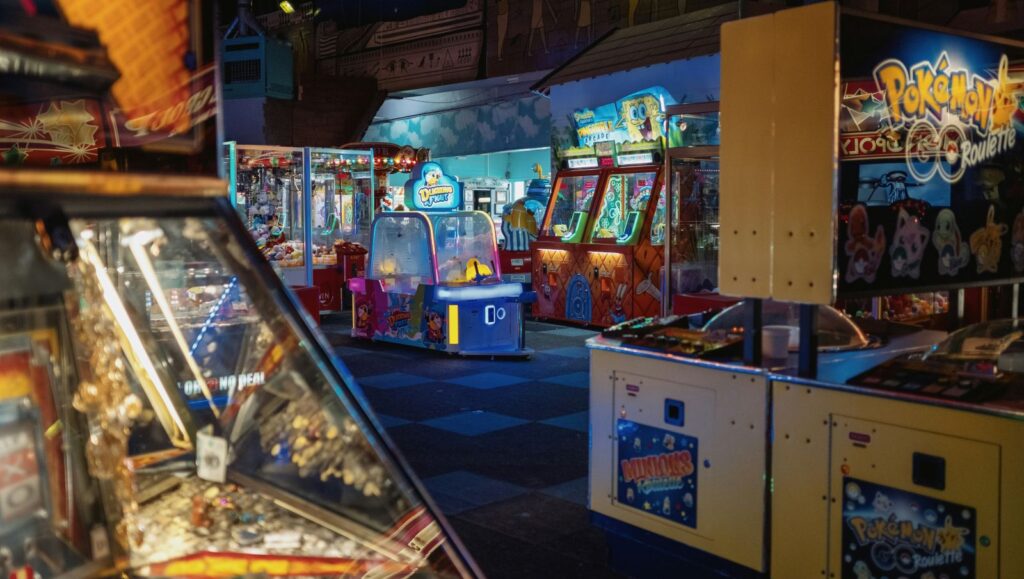
There are several arcades on the Seaside Heights boardwalk. The main ones your family will encounter:
Lucky Leo’s — Open year-round, which says something about how central it is to Seaside Heights. Family-owned since 1953, it’s one of the most recognized arcades on the East Coast. Skee-ball, redemption games, the Wizard of Oz machines that have a cult following among regulars. Lucky Leo’s is the arcade locals actually go to.
Casino Pier Arcade — Inside Casino Pier itself. Larger, newer, more geared toward video redemption games and Virtual Reality. Uses the Surf Card for payment, same card as the rides.
Sonny’s & Rickey’s / Coin Castle — Both on the boardwalk and known for their payout rates. Sonny’s in particular has a reputation among regulars for giving you more value on the play cards than some of the larger arcades.
The general rule: smaller, family-owned arcades tend to have better payout rates on redemption games than larger chain-style ones. Lucky Leo’s and Sonny’s are where locals tend to land when they’re trying to stretch their ticket budget.
Ticket Games: Best Return on Skill
Not all arcade games are created equal. Some are pure chance — the payout is determined before you touch anything. Others actually reward skill and repetition. The key distinction for families trying to make the most of their arcade budget:
- Skill-based games (worth practicing): Skee-ball, basketball hoops, coin pushers (partially), whack-a-mole variations.
- Chance-based games (entertaining but not beatable): Spinner wheels, slot-style light games, most “hit the moving target” games where the outcome is random regardless of timing.
The best arcade strategy is to find one or two skill games you’re good at and play those repeatedly rather than spreading credits across a dozen different games hoping to get lucky on a jackpot. Consistency at skee-ball beats jackpot chasing every time when you’re playing across a full week.
Skee-Ball: The Most Reliable Ticket Machine on the Boardwalk
Skee-ball has been a boardwalk staple since the 1910s, and it rewards genuine skill more than almost any other arcade game. It’s also the game where a practiced player can consistently outperform a casual one — which means your second day will be better than your first, and your fifth day better still.
The basics of good skee-ball form:
Stand with your throwing foot slightly back, braced lightly against the machine. Crouch or bend forward enough to see all the scoring holes clearly — sight lines matter more than most people realize. The motion is more like a bowling release than a throw: smooth, controlled, and consistent.
Where to aim: The 40-point ring is the sweet spot for consistent ticket accumulation. It’s wide enough to hit reliably and scores well. The 100-point corner holes are tempting, but they’re small and inconsistent — even experienced players miss them more than they hit. The math works out better aiming for the 40 every time versus gambling on the 100.
Bank shots: The side walls of the lane can be used to redirect your ball, similar to a cushion shot in billiards. With enough practice you can use the back wall to hit the high-corner pockets more reliably than aiming straight at them. This takes time to develop but is a legitimate technique used by serious players.
The honest truth: Skee-ball is learnable — actually learnable. After two or three rounds your scores will be noticeably better. By mid-week a kid who starts at the bottom of the scoring range can reliably reach the upper range. This is the game to invest practice time in if you want to walk away with prize-counter prizes at the end of the week.
The Claw Machine: What’s Actually Going On
Let’s be clear about how claw machines work, because most people don’t know — and knowing changes how you approach them.
Claw machines are not pure skill games. The grip strength of the claw is controlled by a setting the arcade operator programs in. Most machines are set so the claw grips weakly for most plays, and then — after a set number of plays or dollars collected — suddenly grips at full strength. This is sometimes called the “payout cycle.” The machine literally cannot pick up most prizes most of the time, regardless of how perfectly you position the claw.
New Jersey has regulations governing how often claw machines must pay out, but the intervals can still be quite long. A machine can be set to full-strength grip only once every dozen or more plays. The rest of the time, the claw squeezes and releases before it gets over the chute — that’s not you positioning it wrong, that’s the machine doing what it was programmed to do.
Does this mean claw machines aren’t worth playing? Not entirely. Here’s what actually improves your odds:
Watch before you play. If someone has been feeding the machine for a while with no wins, the payout cycle may be close. A machine that just paid out is less likely to pay out again soon.
Choose machines with room to maneuver. Overpacked machines with prizes wedged against the glass are much harder to win on regardless of grip strength. Look for machines where prizes have space around them and where some are positioned near the prize chute.
Target prizes with limbs. Plush toys with arms, legs, or ears give the claw something to hook onto. Smooth, round items are harder to hold even when the grip is strong.
Aim slightly ahead of the prize. Claw machines have a slight momentum after you release the joystick — the claw drifts a little before it drops. Compensate by positioning the claw just past where you want it to land.
Try the side or hook approach. Instead of always dropping straight down, try positioning the claw so it comes down at a slight angle, allowing one prong to slide under or hook around part of the prize. This works especially well with plush toys.
The honest expectation: Even with good technique and good timing, claw machines are built to pay out infrequently. They’re fun for a few plays. Don’t chase a specific prize across ten credits — pick it up at the prize counter with tickets from skee-ball instead.
The Big Coin Pushers: Wizard of Oz, Avengers, Willy Wonka & Angry Birds
These are the machines that draw a crowd. You’ve seen them — big lit-up cabinets with a familiar license plastered across the front, a pile of tokens and cards shifting on a moving shelf, and at least one kid absolutely convinced they’re one push away from the jackpot. Lucky Leo’s and the Casino Pier Arcade both have them, and they’re worth understanding before you pump credits in.
All four are coin pushers at heart: you fire tokens onto a playfield and try to push coins, cards, and bonus items over the edge for tickets. They’re more engaging than a standard coin pusher because they layer in collectible cards, bonus games, and themed mechanics — but the underlying economics are the same. Skill matters at the margins; the machine’s payout settings matter more.
Here’s what each one actually does and what actually helps.
Wizard of Oz
The one that started the licensed coin pusher craze at boardwalk arcades, and still the one with the most devoted regulars. You’ll find people who check on this machine the way others check box scores.
How it works: You fire tokens using a joystick and rapid-fire button, directing coins onto the playfield to push character cards and tokens over the edge. The eight collectible cards are Dorothy, Toto, Tin Man, Scarecrow, Cowardly Lion, Glinda, the Wizard, and the Wicked Witch. Collect all eight and turn them in for a 5,000-ticket grand prize bonus. Cards and tokens that fall off the edge get redeemed for tickets at the kiosk.
The Toto problem: Toto is the rare card — deliberately seeded into the machine far less often than the others. Without Toto, you can’t complete a set. Regulars will literally look into the machine before playing to see if Toto is visible. If it’s not there, the grand prize is off the table no matter how well you play. This isn’t a myth or superstition; the machine is designed this way to limit complete-set payouts.
Strategies that actually help:
Use the joystick to aim your shots rather than firing randomly. You can direct the coin ramp left, right, or center — use this to target stacks near the edge rather than depositing coins in empty space.
When you see a tall stack of coins near the edge, use a short burst of rapid-fire to add weight on top, then switch back to single timed shots to push it over. Dumping coins continuously in one spot often creates a pile that doesn’t go anywhere useful.
If a stack on the far right or left isn’t moving, aim your shots an inch toward center from that side — a sideways push on the stack from an angle is often more effective than pushing it directly from behind.
The honest verdict: Wizard of Oz is one of the more skill-responsive coin pushers out there — the joystick aiming actually lets you influence where coins land. But the Toto card gating means completing a set is entirely dependent on timing, not skill. It’s a fun game that rewards patient, strategic play. It’s a losing proposition if your goal is to complete a set on demand.
Avengers
The Marvel machine. Developed under the Andamiro-Disney alliance and built around the Infinity Stones storyline, which gives it a built-in bonus structure that’s more transparent than most coin pushers.
How it works: You fire tokens at a rotating target wheel — timing your shots to drop coins through the wheel and onto the playfield. The playfield contains six Infinity Stones (colored gems sitting among the coins). The goal is to push the Stones off the edge: one Stone triggers a Bonus Spin; push all six and you unlock the Super Bonus for a major ticket payout. The card version also has nine Avengers collectible cards — Iron Man, Cap, Thor, Hulk, Black Widow, Hawkeye, War Machine, Black Panther, and Ant-Man — which add a second collection layer.
The wheel mechanic: This is what separates the Avengers from a standard coin pusher. You’re not just dumping coins — you’re timing drops through a moving wheel to place coins precisely. Tokens fired at the wrong moment go through the wrong part of the wheel and land off-target. Tokens fired at the right moment can be steered.
Strategies that actually help:
Watch the wheel for two or three cycles before firing your first token. The wheel speed is consistent — develop a feel for its rhythm before committing credits.
When a Stone is near the edge, shift focus to placing coins directly behind it rather than beside it. A straight push from behind is more effective than side pressure on the smooth-surfaced stones.
If a Stone is near the edge on one side, fire tokens slightly to that side to build a pile that pushes it over rather than pushing it toward the center of the playfield.
The honest verdict: The wheel timing mechanic makes this more interactive than most coin pushers. There’s a real skill gap between players who have developed the timing and those who haven’t. The Infinity Stone bonus structure also means the payout trigger is visible and trackable — you can see how close you are. That transparency makes it more satisfying to play than machines where the bonus feels random.
Willy Wonka
The Elaut follow-up to their Wizard of Oz machine, and the first coin pusher to add a video monitor displaying a game challenge. The chocolate bar mechanic is the key thing to understand here.
How it works: You roll tokens onto the playfield to push coins and character cards over the edge. The video monitor tracks a “chocolate bar” progress meter — each token that lands on the playfield fills the meter slightly. Fill the entire meter and the Bonus Wheel activates, spinning to award a ticket or coin payout. The nine collectible cards are Willy Wonka, Charlie, Augustus, Violet, Veruca, Mike, the Oompa Loompas, the Chocolate Waterfall, and the Golden Ticket. The Golden Ticket card is the rare one — randomly released like Toto in the Wizard of Oz — and completing a full set with the Golden Ticket earns a significant bonus.
The chocolate bar meter is your north star: Unlike some coin pushers where you’re just watching coins pile up, the Wonka machine gives you visible progress feedback. The meter tells you how close you are to triggering the bonus wheel with every token. This makes it easier to budget — you can see whether you’re going to hit the bonus or whether you’re bleeding credits into a slow fill.
Strategies that actually help:
Consistent token placement fills the chocolate bar meter more efficiently than scatter-shot firing. Each token on the playfield advances the meter regardless of where it lands, so you’re not penalized for less precise shots the way you are on the Avengers — but you’re also not rewarded for precision the same way.
Before sitting down to play seriously, check whether the Golden Ticket is visible in the machine. It’s the rare card, and without it a complete set isn’t happening. If it’s not there, treat the session as bonus wheel farming rather than card collecting.
When the bonus wheel is close, resist the urge to rapid-fire — you don’t need to. A steady single-token rhythm fills the meter and keeps you from over-investing before the wheel hits.
The honest verdict: The chocolate bar meter makes Wonka the most legible of the four machines — you always know where you stand. It’s a more relaxing play experience than the Avengers wheel timing or the Wizard of Oz aiming game. The Golden Ticket functions the same as Toto in Oz: a rare-card gate on the grand prize that removes card completion from the realm of pure skill. Play it for the bonus wheels and the fun, not with serious card-set expectations.
Angry Birds Coin Crash
The odd one out in this group — and meaningfully different from the other three in a way that matters for families.
How it works: Instead of a traditional flat-playfield coin pusher, Angry Birds Coin Crash uses a tower-building mechanic. Coins are deposited in a circular pattern, layer by layer, building a literal tower on the playfield. Your goal is to build that tower tall enough to crash it over the edge — at which point you get a significant ticket payout. There’s also a Tower Bonus Meter: fill it during play to trigger a mini-game that adds more coins to the tower before the crash.
What makes it different: There are no collectible cards. No rare items to hunt. No card set to complete. The machine is self-contained and the win condition is always visible — the tower either crashes or it doesn’t. This removes the “where’s Toto” frustration entirely and makes it the most clear-cut of the four.
Strategies that actually help:
Patience is the main strategy here. The tower builds steadily with consistent play — don’t rush it. Rapid-firing early doesn’t accelerate the crash in a useful way; it just burns through credits faster.
Focus on filling the Tower Bonus Meter whenever it’s available. The mini-game adds free coins to the tower, which accelerates your path to the crash payout. Triggering it multiple times before the final crash is the best way to maximize the payout you get when it falls.
Watch the tower’s balance — if it’s growing unevenly, adjust your aim to the lower side to level it out. A lopsided tower can shift sideways rather than crashing cleanly over the edge.
The honest verdict: Angry Birds is the most family-friendly and least frustrating of the four machines. The win condition is transparent, the progress is visible, and there’s no rare card gating the big payout. Kids tend to love watching the tower grow. The tradeoff is that it’s less exciting than the Avengers wheel or the Wizard of Oz aiming game — but if your goal is a fair, legible coin pusher experience, this is it.
The Coin Pusher Verdict Overall
All four machines are more fun than a standard coin pusher, and all four have at least some skill layer that rewards attention. The ranking for families trying to get the most value:
- Best for skill-responsive play: Avengers — the wheel timing mechanic is real and learnable.
- Best for fun, low-frustration play: Angry Birds — transparent win condition, no rare card hunting.
- Best overall experience: Wizard of Oz — the most depth, the most strategy, the most engaged community. Just accept that completing a set depends on Toto showing up.
- Best for younger kids: Willy Wonka — the chocolate bar meter gives constant visible progress feedback that keeps younger players engaged.
One tip that applies to all four: if your machine has a digital readout showing ticket totals or bonus meter progress, check it when you sit down. Some machines carry over bonus progress from the previous player. Starting a session on a machine that’s already 80% of the way to its bonus wheel is a real advantage.
Midway Games: Which Are Worth Playing
The midway games on Casino Pier — Basketball, Balloon Darts, Ring Toss, Frog Bog, and the rest — are a different category from the arcade ticket games. These are prize games: win one and you get a stuffed animal, not tickets. The prizes tend to be larger, which makes them appealing to kids, but the economics are worth understanding.
The general rule on midway games: games of skill with a predictable physical mechanic are beatable. Games of chance are not. Here’s the breakdown.
Water Gun Race
Worth playing. One of the fairer midway games on the boardwalk.
This is a pure race — you aim your water gun at a target, fill a balloon or move a marker, first to finish wins. There’s always a winner every round, which makes it a real hit with kids.
Strategies that work:
Fewer players is better. The fewer competitors, the better your odds. If you can play during an off-peak moment with two or three other players instead of eight, do it.
Lean your gun forward as far as possible on the table before the round starts. Accuracy and stability matter more than reaction time.
Pre-fire. Have your finger on the trigger before the bell goes off. The instant the water starts flowing, you want to already be aimed and firing. Players who wait for the bell lose a fraction of a second that can cost the race.
Keep the stream on target continuously rather than chasing it back after it drifts. Consistent aim beats reactive corrections.
Basketball Hoops
Worth playing. Skill-based, learnable, decent prizes.
Arcade basketball rewards muscle memory above everything else. Once you dial in your release point — the specific arc and force that drops the ball through the hoop consistently — you can repeat it accurately. The challenge is that each machine is slightly different in hoop height, distance, and ball weight.
Strategies that work:
Take your first shot slowly and deliberately to calibrate the feel of the ball and distance. Use that first shot as a diagnostic, not a serious attempt.
Find your release point — the exact spot in your throwing motion where the ball leaves your hand for a consistent result. Replicate it exactly every time.
Use a high arc. Flat shots on small arcade hoops almost always rattle out. A higher arc gives the ball a better angle of entry and more forgiveness on the rim.
Aim slightly toward the back of the rim rather than the center. Rim-and-in from the back is more forgiving than front-rim bounceouts.
Balloon Darts
Partially skill-based, but watch for a few things.
The premise is simple — throw darts, pop balloons, win prizes. The reality is that boardwalk darts are often dull (so they bounce instead of sticking) and the balloons may be underinflated (so they’re tighter and harder to pop).
Strategies that work:
Throw harder than you think you need to. Dull tips need force to pop even a well-inflated balloon. A lob won’t do it — put some speed on the throw.
Aim for fuller-looking balloons over shriveled or soft-looking ones. Fuller balloons pop on impact; soft ones absorb the dart and let it bounce off.
Throw at a downward angle rather than flat. A slight downward trajectory gives the tip a better angle to pierce through rather than skimming across.
The honest truth: The prize structure at most balloon dart booths means you typically need to pop several balloons to get a meaningful prize. Factor in the cost per balloon and decide if you’re playing for the experience or actually trying to win.
Ring Toss
Mostly chance. Hard to win consistently regardless of technique.
Ring toss is the game where the prizes are usually the biggest and the odds are usually the worst. The bottles are closely packed, the rings are sized to barely fit, and the physics are difficult to control.
Strategies that help at the margins:
Throw rings like small frisbees — flat and horizontal, with a slight spin — rather than lobbing them in a high arc. A high arc means the ring hits the bottle mouth at an angle and bounces off. A flat, spinning throw is more likely to catch.
Don’t aim for one specific bottle. With enough spin and a flat trajectory, a ring that hits one bottle can sometimes skip to and land on another. Aim for the cluster, not a specific target.
Throw from the front of the booth, not the back. Get as close to the line as allowed.
The honest truth: Ring toss is the game with the largest prizes for a reason — it’s also one of the hardest. If your kid has their heart set on the giant stuffed animal at the ring toss booth, redirect them to the prize counter and calculate what it would take in skee-ball tickets. It’s almost always more efficient.
Milk Bottle Knockdown
Skill-based — and the physics are beatable once you understand them.
This game looks simpler than it is. The key thing most people don’t know: the bottles are weighted unevenly. The bottom two bottles are heavier than the top one. Aiming for the top bottle just moves it without toppling the base. Aiming dead center may not generate enough force to knock the bottom two over separately.
The technique:
Aim between the two bottom bottles — right at the gap between them. A fast, heavy throw aimed at this low center point forces the two bottom bottles apart and takes everything with them. The throw needs force; this isn’t a finesse game. Step into it.
Identify the weak point of the specific configuration. Sometimes the bottles are arranged slightly off-center — that’s your entry point.
Frog Bog
Fun, partially skill-based, but the physics take a few tries to read.
Frog Bog has you using a mallet to launch rubber frogs onto lily pads in a pool. It sounds absurd. Kids love it. There’s a winner every round.
Strategies that work:
The strike angle on the mallet launch determines where the frog goes. A centered, flat strike sends the frog straight; off-center sends it sideways. Practice a centered strike.
Medium force beats maximum force. Hammering as hard as possible tends to send frogs wild. A firm, controlled strike has more predictable trajectory.
Watch where other frogs are landing before your turn — the machines vary and a few observations tell you whether the pads are running long or short.
Ball in Basket
Skill-based once you understand the key trick.
The instinct is to throw the ball directly into the basket. That almost never works — the ball hits the bottom and bounces out. The basket isn’t catching anything thrown straight in.
The technique:
Aim for the inside back rim, not the center of the basket. A ball that hits the back rim and rolls forward dies inside the basket. A ball that hits the bottom bounces out.
Alternative: use topspin to slow the ball’s bounce. A ball with topspin that hits the rim loses speed quickly and settles into the basket instead of rebounding out.
Loft the throw rather than throwing flat. A higher arc gives the ball a steeper descent angle, which means it hits the back rim at a better angle.
Budget Tips for Families
Pick one arcade and become a regular. Spreading your credits across four different arcades means your kids never improve at any specific game. Pick one — Lucky Leo’s is a good choice for local value and skee-ball — and play the same games enough to get good at them.
Skee-ball is the best return on investment. For a family that wants to walk away with actual prizes, skee-ball beats almost everything else. Practice it consistently across the week and the ticket totals add up fast.
Avoid chasing jackpots. The big jackpot games are designed to pay out rarely. A 500-ticket jackpot on a game you’d have to play 50 times to hit is a worse deal than a 50-ticket payout on a game you can hit 20 times with skill.
Know when to trade up. Most arcades let you save tickets across visits. Accumulating tickets over a week and trading up for one good prize at the end is more satisfying than trading for small plastic items after every session. It also keeps kids engaged across the week — they have something to work toward.
Midway games are entertainment, not investments. Treat midway games like rides — budget for them accordingly and enjoy the experience without expecting to beat the math. The water gun race, frog bog, and basketball are a good time even when you don’t win the biggest prize. Save the prize-hunting budget for the ticket games inside.
The arcades at Seaside Heights are a real part of what makes a week here feel different from a regular beach trip. But the families who get the most out of them are the ones who figure out early which games reward time spent — and don’t burn through three days’ worth of credits on day one chasing claw machine prizes.
If you haven’t locked in your stay yet, our rental at Shoreside Village puts you one block from Casino Pier and a short walk from Lucky Leo’s. Eight beach badges included — check 2026 availability here.
Book Your Seaside Heights Vacation Rental Today
Don't wait! All the best rentals book fast. We have you covered Seaside Heights has hundreds of rental options.
Paid Link
Explore Beach Vacation Rentals
Recent Posts
Arcade Games: Strategies to Win on the Boardwalk

Explore Seaside Heights Boardwalk Restaurants 2026

The Seaside Heights Carousel, 114+ Years Old And Fully Restored

10 Tips for Your Seaside Heights Family Vacation on a Budget

How to Take Sunset Photos: 3 Tips To Stunning Pics
Crabbing in Seaside Heights: Tips, Spots & Rules for 2026

Choose Sunscreen Lotion Like a Pro & Master The Glow!

7 Ultimate Secrets To Enjoy The Beach (and Your Vacation)